%202.svg)
Jaguar Land Rover
Unconfirmed. Two possible threat actors were linked to the attack, but no attribution has been confirmed by JLR, the National Crime Agency, or any government body. June 2026 reporting described advanced ransomware and, notably, no ransom demand at any point. JLR has never characterised the malware or attacker publicly.
Manufacturing
~$258M for JLR, ~$2.5B to UK economy, production shutdown for several weeks
Neither JLR nor any official body has publicly disclosed how the attackers gained access. The best-sourced account available, from the June 2026 New York Times investigation, is that the attackers exploited vulnerabilities in aging technology and had established a foothold months before the attack.
Insufficient IT-OT isolation and excessive blast radius
Initial access vector, actor identity, dwell time, and whether operational technology was reached. The Cyber Monitoring Centre noted in October 2025 that unusually few technical details had emerged publicly. That remains true.
Network Cloaking, Passwordless Access, and Segmentation
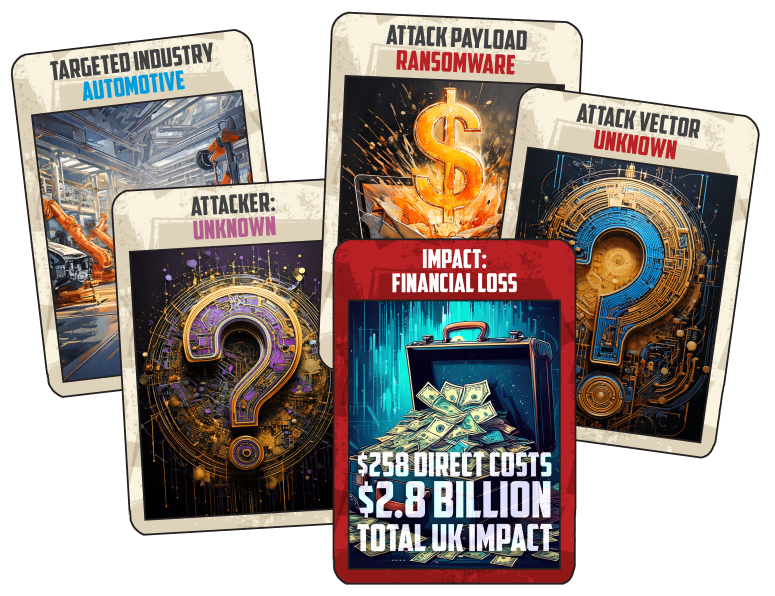
The September 2025 cyberattack on Jaguar Land Rover (JLR) shows how a foothold inside a large enterprise estate can become a massive operational event when the blast radius extends across systems that manufacturing depends on.
The threat actor and initial access vector remain unconfirmed. Scattered Lapsus$ Hunters claimed the attack on Telegram in September 2025, but a New York Times investigation of 26 June 2026 attributed it instead to Russian actors and reported that the Telegram claimants were not responsible. Whether the attack was state-directed, tacitly approved, or the work of a criminal actor operating from Russia is unresolved, and named practitioners dispute the state reading. No attribution has been confirmed by JLR, by the National Crime Agency, or by any government body.
When the attack became disruptive in late August, June 2026 reporting says the attackers unleashed advanced ransomware. JLR’s containment response was to shut down all global systems, and UK manufacturing stopped for approximately five weeks.
JLR reported £196 million in cyber-related exceptional costs for one quarter, and the Cyber Monitoring Centre estimated the UK-wide impact at £1.9 billion across more than 5,000 organizations. The others weren't directly attacked, but were downstream of a manufacturer that stopped. The scale of that blast radius turned a compromise inside one company into a systemic manufacturing and supply-chain event.
The JLR attack highlights how an enterprise compromise can create a blast radius large enough to put manufacturing availability at risk. The attackers had established a foothold inside JLR’s environment before the disruptive phase of the attack, and when the incident escalated, JLR shut down all global systems. BlastWave’s Zero Trust architecture is designed to reduce that blast radius by controlling access and isolating protected OT systems.
Identity-Bound Access: BlastWave ties access to a verified identity on an authorized device, with cryptographic authentication and continuous policy enforcement before a secure connection is established. An attacker operating from a compromised enterprise system cannot rely on network presence or credentials alone to reach protected OT resources.
Manufacturing Cloaking: BlastWave makes protected OT manufacturing systems invisible and inaccessible to unauthorized users, devices, and compromised hosts. An attacker inside the corporate network finds no open ports or responsive systems to scan, while microsegmentation restricts authorized connections to only the resources they require. This confines the blast radius and helps keep manufacturing isolated from affected IT systems.
Editor's note, September 1, 2026
An earlier version of this entry stated as fact that the intrusion began with a vishing call to the Jaguar Land Rover IT helpdesk, in which an attacker impersonating an employee requested a password reset. It also named the Scattered Spider Lapsus$ Hunters collective as the threat actor and described custom ransomware. We have corrected all three.
Jaguar Land Rover has never publicly disclosed how the attackers obtained access. We checked every JLR and Tata Motors statement and results release from September 2025 through the FY2026 annual report, every Hansard debate on the incident, the Business and Trade Committee's published correspondence, the Joint Committee on the National Security Strategy, the NCSC's statement and 2025 annual review, and the Information Commissioner's Office. None of them describes the vector. In the Commons on 9 September 2025, the responding minister discussed helpdesk social engineering in general terms and then said: "I am not saying that that is what happened in this case." The Cyber Monitoring Centre, assessing the incident in October 2025, observed that "for reasons that are currently unclear, fewer technical details about this incident have emerged publicly than is usual in such cases."
We then traced our own claim. The earliest JLR-specific assertion of a vishing vector we could find is an unsourced vendor blog post dated 8 September 2025, whose supporting list of techniques is drawn from a different campaign targeting a different set of victims. Over the following two months, the qualifiers fell away in stages, from "it is possible" to "investigations suggest" to a flat statement of fact, and the reasoning at each step relied on similarities to the Marks & Spencer and Co-op intrusions rather than on any evidence about JLR. The M&S vector is properly sourced, including on-the-record testimony from M&S's chairman before a parliamentary committee. The JLR vector never was. We repeated the claim without checking it.
What first-hand comment exists points the other way. The group that claimed the attack told the Telegraph in September 2025 that it had exploited a known software flaw. A New York Times investigation published on 26 June 2026, sourced to five people close to a multi-agency inquiry, attributed the attack to Russian actors, reported that the Telegram claimants were not responsible, and stated that the hackers "exploited vulnerabilities in aging technology." It further reported that a warning surfaced in June 2025, that JLR responded by rebuilding a vulnerable server critical to the manufacturing pipeline, and that the intruders were already past it. Separately, the man who was JLR's group CISO at the time said publicly in June 2026 that no social engineering was involved. None of this is officially confirmed, and we present none of it as settled.
We have left the impact figures unchanged. They are sourced to JLR's own results and to the Cyber Monitoring Centre and are not in dispute. What this entry no longer claims is knowledge of how the attack started.
Hackopedia exists to be more careful with this material than the surrounding coverage. We published an unsourced claim because it was a good story and it matched a pattern we recognized from adjacent incidents. That is the failure this catalog was built to avoid, and correcting it in public is worth more than the original claim was.


Reading about past failures is only useful if it changes future outcomes. If attackers can see your OT network, they can target it. If they can target it, compliance, safety, and uptime are already at risk.
BlastWave eliminates reconnaissance, initial access, and lateral movement — without agents, without downtime, and without changing IPs, protocols, or PLCs.